Round Two: The 2026 Hyundai IONIQ 9 Performance Calligraphy


2026 has been a long year. Yeah, I know. Some of you are right there with that sentiment, others are ready to point out that there are 365 days in '26, just like all the others.
But I don't mean any of that. I'm talking about the 2026 model year for the Hyundai IONIQ 9.

The IONIQ 9 was one of the earliest 2026 models you could buy, coming to market in the spring of 2025, about six months ahead of whatever remains of the typical new car introduction schedule.
As a result, I've already reviewed a 2026 Hyundai IONIQ 9 in Performance Calligraphy trim, something neither Hyundai nor I realized until I already had the second one. The only difference is that one was in Cosmic Blue Pearl, which is a no-cost paint color, and this one is Snow White, which costs $500 (proceeds going to the legal defense fund once Disney's attorneys get wind of it).
That parenthetical was a joke.
Maybe.
There have been no significant running changes in the model year, so let me just quote my own review to cover the essentials:
It's an incredibly refined machine. And, intended as the electric companion to Hyundai's knockout new 2026 Palisade, that's no surprise.
A bunch of the credit for the otherworldly feeling of refinement goes to RANC---Hyundai's world's first Road-noise Active Noise Control. And it's not just quiet, it's smooth, with a MacPherson suspension up front and multi-link in the rear, with self-leveling dampers and hydro-bushing.
Precision isn't sacrificed for that ride comfort, either---its dynamic torque vectoring makes it a joy to drive on winding roads.
There are five trim levels of IONIQ 9, and they all get between 311 and 335 miles per charge (EPA estimates, your range may vary).
That means the IONIQ 9 picks up where the EV9 leaves off (its five trim levels get between 230 and 305 miles per charge). The trim level I drove, the IONIQ 9 AWD Performance Calligraphy, is a 311-miler (again, your range may vary).
The IONIQ 9 is one of the first non-Tesla vehicles to have NACS as standard. Other automakers are keeping their CCS ports and including adaptors with their cars.
That move gives IONIQ 9 drivers a lot more flexibility in charging, allowing use of the 15,000 Tesla Supercharger locations nationwide.
There are 21.9 cubic feet of cargo space behind the third-row seats of the IONIQ 9, topping the Kia EV9's 20.2.
That expands to 46.7 cubic feet with the third row folded---and again, that beats cousin Kia's 43.5. Folding the second row bumps available space up to 86.9 cubic feet, while the EV9 manages only 81.
Not counted in the cargo numbers is the IONIQ 9's frunk (front trunk), because there really isn't one---it's just a small bin that's already packed with a tire mobility kit, 120-volt AC charger and adapters.
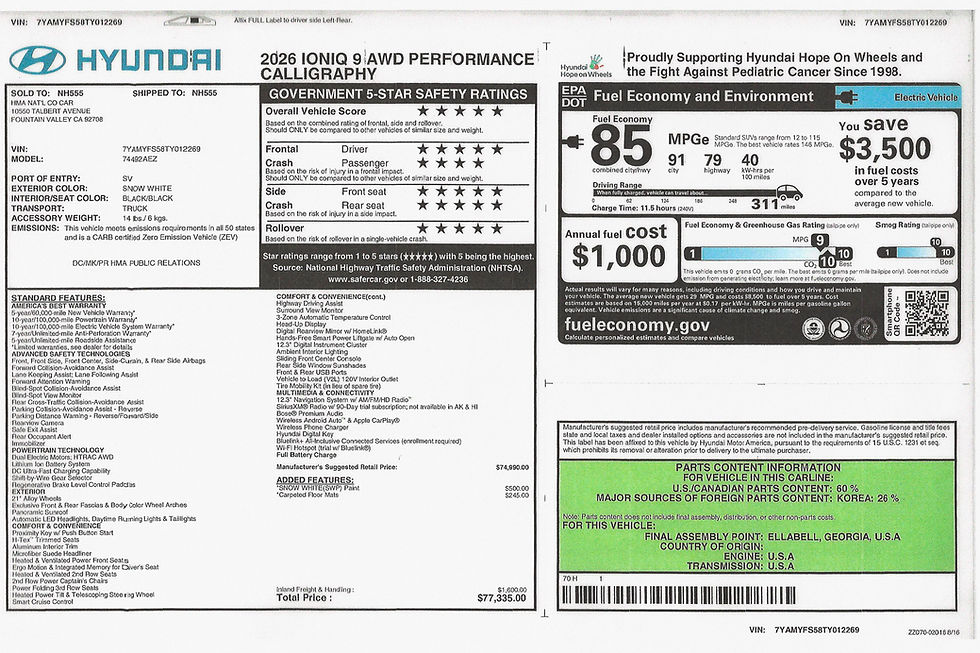
As for the here and now, the base price of a 2026 Hyundai IONIQ 9 Performance Calligraphy is $74,990 ($76,590 including destination). That money buys a bunch of standard equipment (see the window sticker at the end of this review).
Extra-cost options came down to just the Snow White paint ($500) and carpeted floor mats ($245), so the bottom line on the window sticker reads $77,335.
And my conclusion is no different from last time, so, back to the self-quote:
That is not an insignificant price tag, but the 2026 Hyundai IONIQ 9 is not an insignificant vehicle. This looks, feels and drives every bit of 80 grand. It and the gasoline and hybrid Palisades make a formidable lineup of three-row SUVs.
2026 Hyundai IONIQ 9 Performance Calligraphy at a glance:
Price: $74,990 base/$77,335 as tested
Battery: 110.3 kWh
Horsepower: 422
Torque: 516 lb-ft
Transmission: One-speed automatic
Curb Weight: 6,008 lbs.
0-60 Acceleration (manufacturer data): 4.9 seconds
EPA Fuel Economy Estimate: 85 MPGe
Charging time: 24 minutes (10%-80%)
EPA Range Estimate: 311 miles
Class competitors: Kia EV9, Jeep Wagoneer S