

Plugged In: The 2026 Toyota Prius Plug-In Hybrid


I'm often amazed at how things that should be earth-shaking sometimes aren't.
When Toyota Priuses (Prii?) were slow and ugly, you saw them everywhere. You couldn't go a block without it. They sold in huge volumes.

We are beginning the fourth model year of the "new" Prius (introduced for 2023)and I'm still getting "Hey, mister. What kinda car is that? I've never seen it before."
When the new Prius dropped, I (and more than a few automotive journalists) thought this was going to sell like hotcakes. A Prius that maintained the fuel efficiency of previous generations, but that had more-than-respectable performance (0-60 in 7.0 seconds for the hybrid, 6.6 seconds for the plug-in) and a body that is a lot closer to "Italian sports car" than "ugly appliance on four wheels".
And yet, here we are---selling about 65% as well as it did five years ago, when it was largely regarded as a blight on the public motorways.


I don't know what to tell you. Y'all are missing out. The "new" Prius is a delightful compact with solid acceleration, great handling (that lower center of gravity pays off) and fuel economy that is still worth writing home about.
This is the Prius Plug-in Hybrid (known in previous generations as the Prius Prime). Regular readers know I'm a fan of plug-in hybrids in general. Charge the car overnight at home and wake up to a given number of miles of pure electric range before the very thrifty hybrid gasoline/electric system kicks in to do the rest.
Remember to charge and if your daily mileage is less than that number, you can go a long time between fill-ups. Most of that distance (there are exceptions for hard acceleration) will be without using a drop of gasoline or putting a particle of tailpipe pollutants into the air.
In the case of the Prius Plug-In Hybrid, that pure electric range is a pretty solid 40 miles. And when the hybrid takes over, the fuel economy remains strong, at 48 mpg. Combined, the EPA's fuel economy equivalent rates the Prius Plug-In at 114 MPGe, and the estimate is that you'll save $4,500 in fuel costs over five years compared to the average new vehicle.


There's 20.3 cubic feet of cargo space behind the rear seats. Those fold in a 60/40 configuration, so you can still carry one or two passengers and fold the unused seat for more cargo room. If it's just you or you and a front passenger, both sections can fold for a bunch more room (Toyota cites a figure of 26.7, but there's more than an additional 6.4 cubic feet gained from that).

Rear seat passengers get a solid 35.7 inches of legroom, but you can see the curvature of the roof begin to reduce headroom---taller passengers might feel cramped.


I drove the 2026 Toyota Prius Plug-In Hybrid in the next-to-the-top Nightshade trim (which is really the mid-level XSE with dark trim and wheels). Base price is $37,795 ($38,990 including destination) and standard equipment includes a dual-voltage (120V and 240V) home charging cable, a comprehensive suite of active safety features, 19-inch black alloy wheels, Bi-LED headlights and LED daytime running lights, an eight-inch touchscreen, a six-speaker audio sytem with wireless Apple CarPlay and Android Auto, synthetic leather seating, carbon fiber dashboard trim, an eight-way power driver's seat with lumbar adjustment, a heated steering wheel, six USB ports and a wireless phone charger.


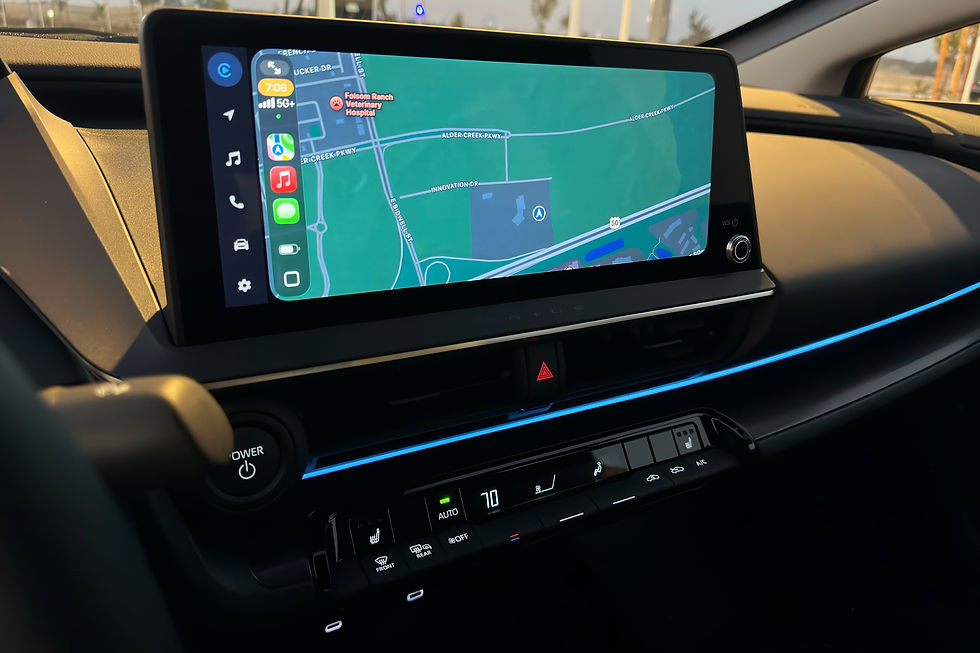
Despite that healthy list of standard features, our vehicle also had some extra-cost options---$275 to make it digital key-capable, $610 for the upgraded 12.3-inch center screen with an eight-speaker JBL audio system, $1,000 for a fixed glass roof, $20 for key gloves, $90 for alloy wheel locks and $319 for carpeted floor and cargo mats.
That brings the bottom line on the window sticker to $41,304.


The "new" Prius is a sleeper that more people should wake up to. While the price tag may seem steep to those who've been out of the market a while, it's almost nine grand less than the average new car price today. Factor in the money you'll save on fuel if you charge it religiously and use that 40 miles of pure EV driving and the 2026 Toyota Prius Plug-In Hybrid could be the right vehicle for uncertain times.

