

Lyriqal Power: The 2026 Cadillac Lyriq-V


Power ebbs and flows. In 1966, when the Sacramento Municipal Utility District (SMUD) bought the land where it would build the Rancho Seco Nuclear Generating Station southeast of Sacramento, California, Cadillac was perhaps the most powerful brand in American automobiles.

By the time Rancho Seco began generating power in 1975, the "Standard of the World" was trying to live on past glory as fuel prices rose and American luxury buyers began to switch allegiances to Mercedes-Benz and other European imports.
Rancho Seco had a short and troubled life. Necessary improvements to the plant resulted in increased power bills for SMUD customers, and after just over 14 years in operation, on June 7, 1989, Sacramento residents voted to shut it down.
And in 1989, Cadillac wasn't looking a whole lot better.

As Arthur St. Antoine wrote in the April, 1989 issue of Car and Driver:
"But what of the long view? The traditional market that the Fleetwood appeals to—a market made up mostly of older buyers weaned on big Caddys—is dying out. And by continuing to build lifeless behemoths, Cadillac is ignoring the huge potential market of younger buyers who may soon be looking for their first prestige sedan. By failing to create a more contemporary image, Cadillac is ensuring that buyers weaned on Hondas and Tauruses will skip the Cadillac store and head straight for their nearby Infiniti, Lexus, and BMW dealerships."
Which, in the 1990s, is exactly what happened. And since 2002, Cadillac has been trying to undo that.
In the 24 model years since, Cadillac has made some great performance cars, including the CT5-V and CT4-V Blackwing. But those are V-8 powered sedans at a time when both V8s and sedans are endangered species. It's an SUV world. And in the long run (the changing winds of domestic politics aside), it's very likely to be an EV world as well.
Cadillac, having learned its lesson about standing too still for too long in the 80s, committed to electrification. It now offers eight EV SUV models, the Optiq and Optiq-V, the Vistiq, the Escalade IQ and Escalade IQL, the ultra-lux Celestiq, the Lyriq and the Lyriq-V.
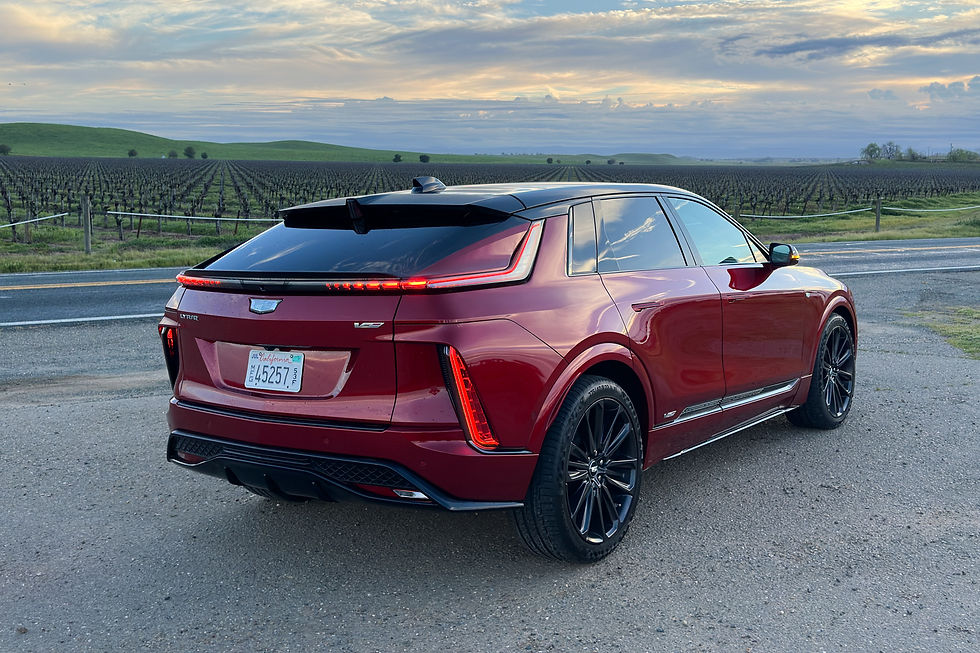
In its standard trim, the Lyriq is a remarkable vehicle---Zero to 60 in 5.7 seconds, with 365 horsepower, 325 lb-ft of torque, 326 miles of range and a base price of $59,200 ($60,995 including destination).
But this is the Cadillac Lyriq-V, and it is another animal entirely---the quickest Cadillac ever. How quick? Zero to 60 in 3.3 seconds. The Lyriq-V offers 615 horsepower, 650 lb-ft of torque, 285 miles of range and a base price of $78,595 ($80,390 including destination).
In a week with the Lyriq-V, I found the range estimate to be as credible as Shakira's hips, as is Cadillac's charging time estimate of 41 minutes to go from 10% to 80%. I rolled up to this Electrify America with a 13% state of charge (SOC) and left with 80% in 37 minutes.

Dipping your right foot into the accelerator pedal might make you think there's a nuclear reactor under the hood, given the massive, seemingly endless amount of torque on tap.
Selectable drive modes allow for near-silent cushy cruising or aggressive speed and handling, with an artificial engine noise that, unlike the ones in the Dodge Charger Daytona or the Hyundai IONIQ 5 N, doesn't feel gimmicky. It's just a low, mellow roar that sounds exactly like what a big engine inside a well-insulated Cadillac should sound like. And if you don't like it, you can silence it and keep the all-out performance.


There is no front trunk ("frunk) in the Lyriq-V. That space, enshrouded in plastic that Cadillac calls an "underhood sight shield", is all electricals. The one recommended user maintenance item---the washer fluid refill---is that white neck with the black cap on the left.
That leaves the rear cargo area for luggage, and there's 28 cubic feet of space behind the rear seat. Fold that flat and you've got 60.8 cubic feet.

Rear seat passengers get a comfortable 39.6 inches of legroom.


Our test vehicle was the Lyriq-V Premium. Base price $83,795---$85,190 with destination. That money buys a huge list of standard features (see the window sticker at the end of the review).
This one did have some extra-cost options---$1,225 for the Radiant Red Tintcoat paint, $595 for the red-painted brake calipers, and a $500 "California Emissions Requirements" fee, intended to offset California's warranty requirements, which are stronger than those of the federal government.
The good news---the Lyriq-V is one of the GM vehicles that still has Apple CarPlay and Android Auto.
Bottom line on the window sticker: $87,510.


Maybe I've been breathing the rarefied air of the Lyriq-V's Nappa leather interior too long. Maybe the radiation has gotten to me (just joking---Rancho Seco's nuclear waste was trucked off to Utah decades ago), but that actually hits me as a reasonable price for the levels of luxury and performance here. I've driven a lot of vehicles that cost more and delivered less.
The Lyriq-V could get Cadillac back to "Standard of the World" status in a big hurry. And it takes "Breakthrough" to a new level.
2026 Cadillac Lyriq-V at a glance:
Price: $83,795 base/$87,510 as tested
Battery: 102 kwH
Horsepower: 615
Torque: 650 lb-ft
Transmission: One-speed automatic
Curb Weight: 5,990 lbs
0-60 Acceleration (manufacturer data): 3.3 seconds
EPA Fuel Economy Estimate: 80 MPGe
Manufacturer Range Estimate: 285 miles
Manufacturer charging time estimate: 41 minutes (10%-80% via DC fast charger)


